
Did you know that Singapore’s average relative humidity of 84 percent makes your home a literal incubator for fungal growth? Those tiny black spots on your fabric are more than just an eyesore. They are active colonies that trigger respiratory issues and embarrassing odors. If you have noticed these stains, you aren’t alone. Most homeowners struggle to keep their drapes fresh in our 27°C tropical climate.
It is frustrating to see expensive blackout curtains ruined by stains. We understand the fear of damaging delicate fibers with harsh DIY chemicals that often do more harm than good. You want a healthy, mould-free home without the stress of a failed cleaning experiment. This 2026 guide shows you how to handle curtain mould removal singapore effectively by targeting the microscopic roots of the problem, not just the surface discoloration.
Discover how to identify early signs of infestation and learn why professional on-site steaming, with prices starting from S$35 per piece at top providers, is becoming the top choice for busy urbanites. We will also share practical prevention tips to ensure your curtains stay spotless and your air stays clean.
Key Takeaways
- Learn why Singapore’s 84 percent humidity turns your windows into a “greenhouse” for fungus and how to stop the cycle before it starts.
- Master the “Sniff Test” and visual cues to instantly tell the difference between harmless grey dust and active, deep-set fungal colonies.
- Avoid the “bleach trap” and discover why professional curtain mould removal singapore is the only way to kill spores at the root without ruining delicate fabrics.
- Implement the “Air Gap” hanging technique and optimized climate control settings to ensure your drapes stay fresh and mould-free for the long term.
Why Curtain Mould is a Critical Issue in Singapore
Curtain mould isn’t just a dirty smudge on your fabric. It is a living, breathing fungal colony. These organisms thrive on the organic particles like dust, pet dander, and skin cells that get trapped deep within your curtain fibers. In our local environment, this isn’t just a cosmetic annoyance; it is a serious health hazard. Curtains act like the “lungs” of your home. They filter the air you breathe, but they also trap moisture. When that moisture stays, the mould moves in. Professional curtain mould removal singapore starts with understanding why this happens so frequently in our HDBs and condos.
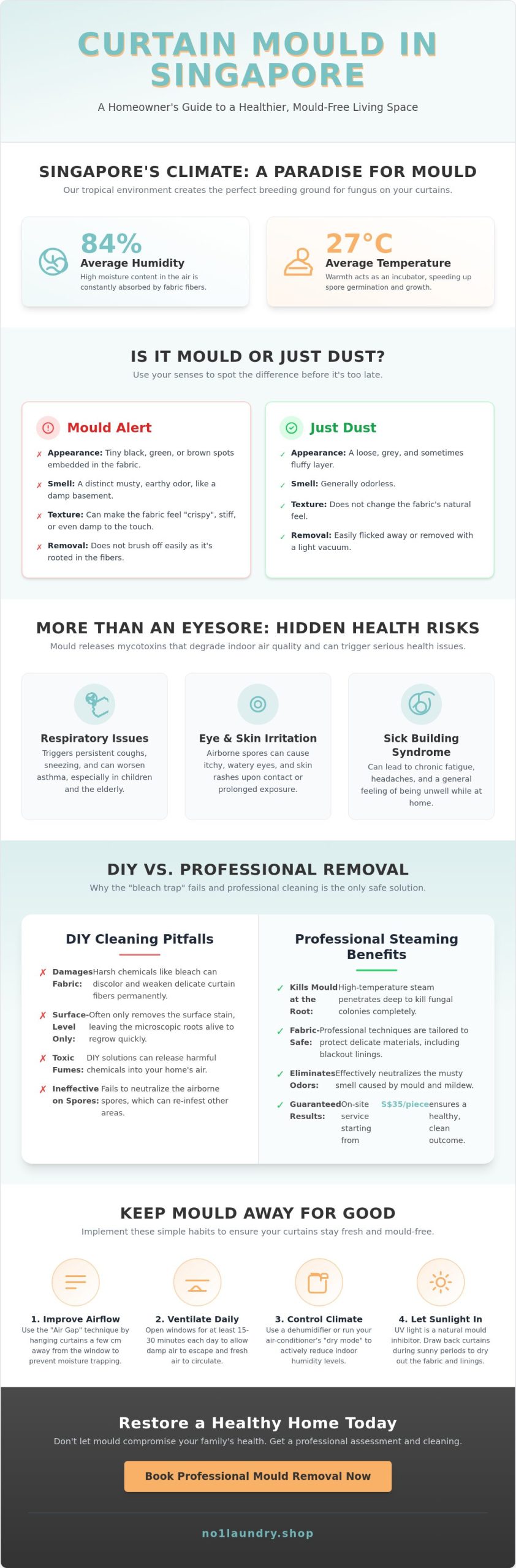
Singapore’s tropical climate is a paradise for fungi. With an average relative humidity of 84 percent and temperatures hovering around 27°C, your window treatments are under constant attack. We often see a “greenhouse effect” happening right behind your drapes. The space between the window glass and the fabric becomes a pocket of stagnant, moist air. This is the perfect incubator for spores to multiply. Ignoring the problem only makes it harder to fix, which is why curtain mould removal singapore is a top priority for health-conscious homeowners.
The Science of Humidity and Fabric
Condensation is the biggest culprit. When you run your air-con at night, the window glass gets cold. Once you turn it off, the humid morning air hits that cold surface. Water droplets form and soak directly into your night curtains. This dampness, combined with organic dust, provides an all-you-can-eat buffet for mould. High-rise living often limits natural cross-ventilation. This means moisture has nowhere to go. It just sits there, feeding the fungus until the fabric begins to deteriorate and stains become visible.
Health Risks You Cannot Ignore
Living with mouldy curtains can lead to “Sick Building Syndrome.” You might feel constantly tired, have itchy eyes, or suffer from a persistent cough without knowing why. These are common health risks of mould exposure that many Singaporeans overlook. Children and the elderly are particularly vulnerable to these airborne spores. Mycotoxins are toxic chemical products produced by fungi that severely degrade indoor air quality and can trigger long-term respiratory issues. If you notice your family sneezing more often, it is time to look at your window treatments and act fast to restore a clean environment.
Identifying Mould vs. Dust on Your Curtains
Don’t confuse a simple layer of dust with a fungal invasion. Dust is a surface issue. It looks grey, fluffy, and sits loosely on the fabric. You can usually flick it off with a finger or a quick vacuum. Mould is far more stubborn. It appears as tiny peppercorn spots or ink-like splatters in shades of black, green, or brown. These spots are physically embedded in the textile fibers. If you try to brush them away and they don’t budge, you likely need professional curtain mould removal singapore to save your drapes.
Your nose is often the best diagnostic tool. Active fungal growth produces a distinct, earthy scent similar to an old basement or a wet towel left in a gym bag. This damp odor is caused by microbial volatile organic compounds released as the fungus feeds. Even if you cannot see visible spots yet, a lingering musty smell near your windows is a major red flag. According to the U.S. EPA on mould health effects, these airborne particles can cause significant irritation to your eyes, skin, and lungs if left untreated.
Texture is another dead giveaway. High-quality fabric should feel soft and pliable. When mould takes hold, it often makes the material feel “crispy” or unusually stiff, especially along the bottom hems. This happens because the fungus breaks down the fabric’s structural integrity. Focus your inspection on the window-facing side and the bottom 10 centimeters of the curtain. These areas are the first to suffer since they sit closest to window condensation and floor-level moisture.
Types of Mould Common in Singaporean Homes
Aspergillus is the most frequent visitor in local homes. It often looks like powdery grey or yellowish patches on day curtains. Cladosporium is the variety responsible for those dreaded black spots on blackout linings. To tell if the mould is “active,” look for a fuzzy texture or a slight dampness to the touch. If the area is bone-dry and hasn’t changed size in months, it might be a “ghost stain” from a previous infestation, but it still requires deep cleaning to remove the dead spores.
Hidden Mould: Checking the Linings
Many modern Singaporean homes use heavy night curtains with blackout layers. These create a “sandwich” effect where moisture gets trapped between the decorative fabric and the rubberized lining. Mould loves this dark, damp gap. You might not see the growth from the front, but the spores are still circulating in your room. If your curtains have a mysterious smell or you see faint, shadowy “ghosting” stains appearing on the front, it is time to consult a professional cleaning service before the damage becomes permanent.
DIY vs. Professional Removal: The Reality Check
Many homeowners reach for a bottle of bleach the moment they spot a black stain. It seems like a quick fix, but it is actually a “bleach trap.” Bleach is an oxidizer that strips the color from the mould, making it invisible to the eye. It doesn’t always kill the microscopic roots, known as hyphae, that are woven into the fabric. Within weeks, the spots reappear. Even worse, harsh chemicals can eat away at the delicate threads of day curtains, making them brittle and prone to tearing. For a permanent solution, curtain mould removal singapore requires deeper penetration than a surface spray can provide.
Scrubbing at home is another hidden danger. When you vigorously rub a mouldy patch, you aren’t just cleaning; you’re launching millions of invisible spores into the air. These spores settle on your carpets, upholstery, and even inside your air-con vents. You might clear one spot only to find a new colony growing on your sofa a month later. Most home washing machines also lack the capacity and temperature control needed for true sterilization. They simply cannot maintain the sustained heat required to neutralize stubborn fungal species without damaging the fabric.
Common DIY Mistakes to Avoid
Thermal shock is a frequent disaster for Singaporean drapes. Homeowners often use boiling water to kill germs, only to find their expensive floor-to-ceiling curtains have shrunk by 10 percent. Incomplete drying is the next big hurdle. In our humid climate, a curtain that feels “mostly dry” is actually a damp petri dish. Hanging them back up while they still hold moisture leads to instant regrowth. Never mix cleaning agents. Combining bleach with ammonia-based window cleaners creates toxic chloramine gas, which is a serious safety risk in small HDB apartments.
When is it Time to Call the Pros?
We recommend the “25% Rule.” If mould covers more than a quarter of the curtain’s surface area, the infestation is too deep for home remedies. Professional intervention is also non-negotiable for delicate materials. Silk, velvet, and specialized blackout coatings require specific pH-balanced solvents. You can learn more about how different fabrics react to treatment in this Curtain Cleaning Singapore: The Ultimate 2026 Homeowner’s Buying Guide. Research on preventing mildew on household fabrics proves that professional-grade anti-fungal agents are the only way to ensure your home stays healthy and fresh for the long term.
The No.1 Laundry Professional Removal Process
Removing fungi from fabric isn’t a surface-level job. At No.1 Laundry, we’ve developed a rigorous four-step protocol designed specifically for the curtain mould removal singapore homes require to stay healthy. We don’t just aim for visual cleanliness; we target the biological roots of the infestation to ensure your living space is truly hygienic. Our specialized curtain mould removal singapore process ensures that every fiber is sanitized and restored to its original glory.
- Step 1: Professional Assessment. Our experts examine the fabric type, weave density, and the extent of the fungal growth. We perform sensitivity tests to ensure the cleaning agents won’t cause discoloration or shrinkage.
- Step 2: Spore Neutralization. We apply specialized anti-fungal agents that penetrate deep into the fibers. This step kills the active spores and the hyphae roots that domestic detergents often miss.
- Step 3: High-Extraction Cleaning. Depending on the material, we use industrial laundering or dry cleaning. Our high-extraction technology pulls dead spores and loosened stains out of the fabric entirely.
- Step 4: Controlled Industrial Drying. We use moisture-monitored drying chambers. This ensures your curtains are 100 percent dry before they are packed, leaving no room for immediate regrowth.
Neutralization vs. Just Washing
Most people think a standard wash cycle is enough. It isn’t. Our 2026 anti-fungal treatment goes beyond basic cleaning by creating a temporary protective barrier on the fabric fibers. This barrier makes it harder for new spores to settle and feed. We use pH-balanced solutions to preserve the original “drape” and vibrancy of your curtains, whether they are heavy velvet or delicate lace. Professional extraction machines remove significantly more water and debris than a home washing machine’s spin cycle, preventing the grey look that often plagues DIY attempts.
The Convenience of Delivery
We know you’re busy. Managing heavy floor-to-ceiling drapes is a workout you don’t need. No.1 Laundry takes care of the heavy lifting with our door-to-door pickup and delivery service. We offer a fast 48-hour turnaround for most standard orders, so you won’t have to live with bare windows for long. If you want to see how this fits into your overall home maintenance, check out The Ultimate Guide to Laundry Service in Singapore (2026) for a full breakdown of our expert offerings. Ready to breathe easier? Book your professional curtain treatment today and let us handle the grime.
How to Prevent Curtain Mould from Returning
Prevention isn’t a one-time event; it’s a lifestyle for your home. After completing a professional curtain mould removal singapore service, your goal is to make the environment as hostile as possible for new spores. Fungi need three things to thrive: food in the form of dust, moisture, and stagnant air. If you remove even one of these, you break the cycle. In a city where the outdoor humidity hits 84 percent daily, you have to be intentional about your indoor climate.
Start with the “Air Gap” technique. Most HDB and condo window tracks are installed too close to the glass. If possible, ensure a 5 to 10 centimeter gap between the window and your drapes. This prevents condensation from transferring directly onto the fabric. Use your air-con’s “Dry Mode” during the monsoon season. This setting specifically targets moisture without over-cooling the room. Aim for an indoor relative humidity level of 50 to 60 percent to stop fungal growth in its tracks. It is a small adjustment that saves your expensive blackout linings from permanent damage.
Environmental Adjustments
Small changes yield big results. Place moisture absorbers, like activated charcoal or silica gel canisters, directly on your window sills. These are readily available at local hardware stores for under S$10 and act as a first line of defense. Don’t underestimate your ceiling fan. Running it for just 30 minutes a day helps disperse the damp air pockets that form behind heavy night curtains. If you use a hand-held steam cleaner for light maintenance, always ensure the fabric is 100 percent dry before closing the curtains. Trapping steam behind a closed drape is a direct invitation for trouble.
Your Mould-Free Checklist
Consistency keeps the air clean and your fabrics bright. Follow this simple schedule to protect your investment and your health:
- Weekly: Use a vacuum with a HEPA-filter attachment to remove organic dust. This starves any potential spores of their primary food source.
- Monthly: Pull your curtains back and inspect the linings and bottom hems. Catching a single spot early makes curtain mould removal singapore much easier and more affordable.
- Bi-Annually: Schedule a professional deep clean. Over a six-month period, even the best-kept curtains accumulate microscopic particles that only industrial-grade extraction can remove.
Don’t wait for the musty smell to return to your living room. Schedule your curtain mould removal with No.1 Laundry on WhatsApp today! and keep your home’s air quality at its peak.
Enjoy a Fresh and Healthy Living Space
You don’t have to live with musty smells or unsightly black spots. We’ve explored how Singapore’s 84 percent average humidity fuels fungal growth and why surface-level scrubbing often fails to kill deep-set roots. Choosing expert curtain mould removal singapore ensures that spores are neutralized at the fiber level while protecting your expensive blackout linings from chemical damage. It’s the smartest way to safeguard your family’s respiratory health.
No.1 Laundry makes this essential maintenance completely effortless. We use eco-friendly anti-fungal treatments that are safe for your household and incredibly tough on stubborn fungi. Our team handles everything with a convenient national home delivery service and a fast 48-hour turnaround time. You’ll get your drapes back looking immaculate without lifting a finger. Book your professional curtain mould removal via WhatsApp today and start breathing easier in a cleaner, brighter home. It’s time to let the light back in!
Frequently Asked Questions
Can mouldy curtains be saved or should I throw them away?
Most curtains can be saved if you act before the fungus digests the structural integrity of the fabric. Professional curtain mould removal singapore services use industrial-grade surfactants that reach deep into the weave to neutralize the infestation. You should only consider throwing them away if the material has become paper-thin or tears easily when handled, which indicates the mould has caused irreversible rot.
Is it safe to sleep in a room with mouldy curtains?
It isn’t advisable to sleep in close proximity to active fungal growth. As you sleep, you’re breathing in microscopic spores and metabolic byproducts that can cause overnight nasal congestion or skin irritation. Since your bedroom is where you spend the most time, keeping your window treatments sterile is a critical step for maintaining healthy indoor air quality and ensuring restful sleep.
Does dry cleaning actually kill mould spores?
Dry cleaning is highly effective because it combines moisture-free solvents with high-temperature drying cycles that fungi cannot survive. These professional solvents dissolve the organic oils and dust that mould uses as a food source, effectively starving any remaining particles. Unlike home washing, this process ensures the fabric is completely sanitized and bone-dry before it returns to your home environment.
How much does professional curtain mould removal cost in Singapore?
Market rates as of May 2026 typically start around S$13.00 per piece for day curtains and S$14.50 to S$16.50 per kilogram for night or blackout drapes at providers like Clean Care. For those who prefer on-site solutions, premium steam cleaning services generally begin at approximately S$35.00 per piece. These prices reflect the specialized chemicals and equipment needed to ensure the spores are fully neutralized.
Can I use vinegar to remove black mould from my curtains?
While white vinegar is a great natural disinfectant that kills many fungal species, it rarely removes the dark, stubborn stains left behind on the fabric. Vinegar is also highly acidic and can weaken certain delicate fibers if not rinsed out perfectly. For a result that looks as good as it smells, professional curtain mould removal singapore is usually necessary to lift the deep-set pigmentation without damaging the material.
How long does the professional mould removal process take?
At No.1 Laundry, we prioritize efficiency and typically offer a 48-hour turnaround for standard curtain orders. This timeframe allows us to complete a full assessment, perform deep-fiber neutralization, and ensure the curtains are industrially dried. We know you value your privacy and light control, so we work quickly to get your drapes back on your windows as soon as possible.
Will the mould stains completely disappear after cleaning?
In most cases, active stains are removed entirely, but “ghosting” can occur if the mould was left untreated for several months. Ghosting happens when the fungus has actually “eaten” some of the fabric’s dye or changed the texture of the thread itself. While the curtain will be biologically clean and safe to use, a very faint shadow might remain on light-colored fabrics if the damage was extensive.
How can I tell if the mould is growing back?
Your first warning sign will likely be a faint, earthy smell when you draw the curtains in the morning. You can also perform a quick visual check for tiny, peppercorn-sized spots on the side of the fabric facing the window. If the bottom hems feel unusually stiff or “crispy” to the touch, it is a sign that moisture is accumulating and a fresh cleaning cycle is needed soon.